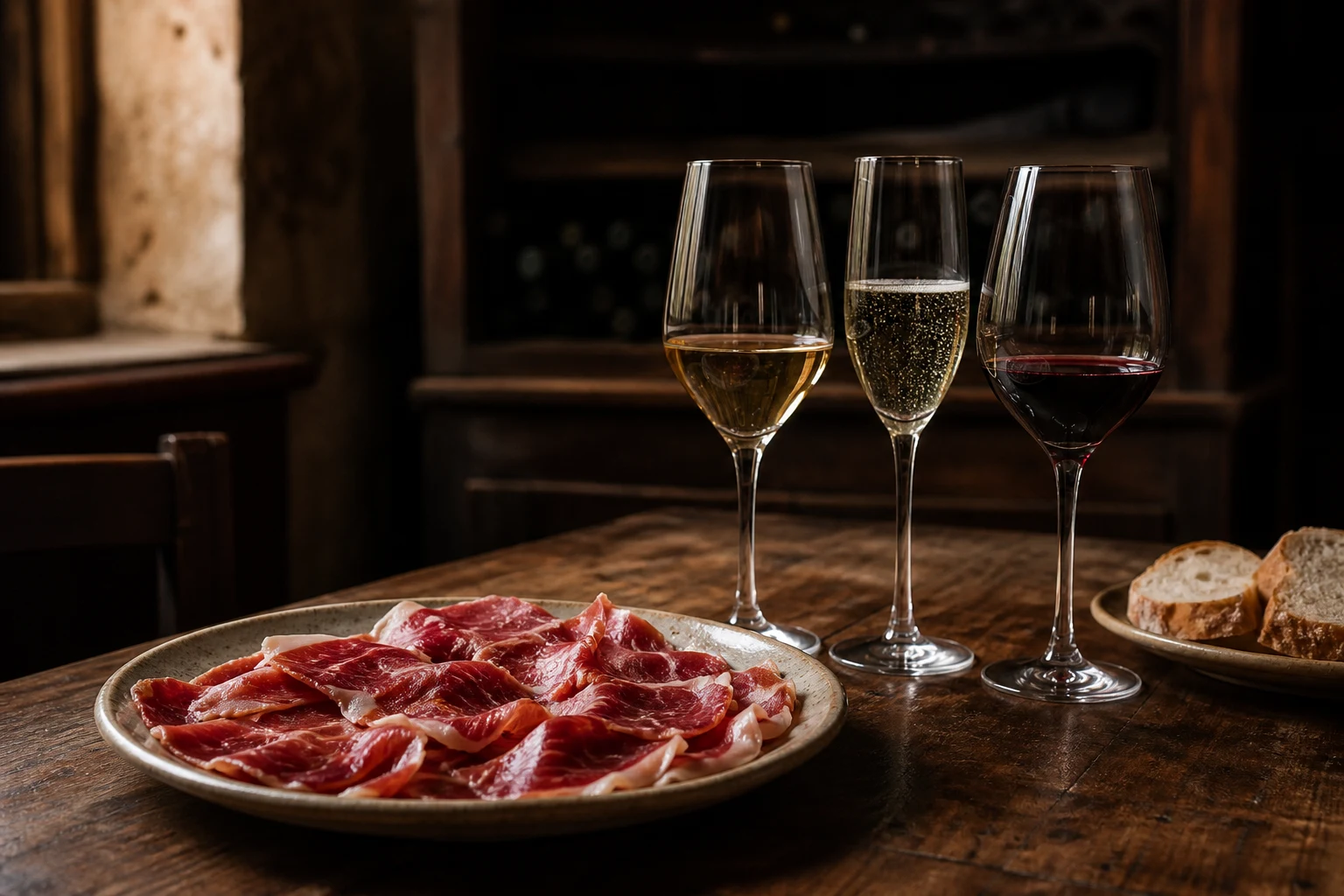
Choose fino, manzanilla, cava, amontillado, white or red wine for your ham and dish.
A quick choice
Decide whether you want dry saline flavours, bubbles or fruit. Start with fino or manzanilla for the first, brut cava for the second and a fresh red with gentle tannins for the third. Prestige alone is not a pairing criterion: a powerful bottle is not necessarily a better partner.
Ham first, then the glass
Try a slice and notice saltiness, the weight of fat and aromatic persistence. Look for a wine that accompanies that intensity. Pairing is a matter of taste, not a price hierarchy.
Three tasting directions
Fino and manzanilla offer dryness and a saline profile; cava adds acidity and bubbles; a fresh red adds fruit with gentle tannins. The Sherry council recommends fino with ham, and D.O. Cava suggests long-aged cava with Iberian ham. [1][2]
When to choose red wine
Avoid aggressive tannins, high alcohol and dominant oak with delicate slices. Try a light red, served slightly cool, particularly when ham is part of rice or mushrooms. This is an editorial suggestion for comparison.
A home tasting
Serve the same ham in one layer, with water and plain bread. Compare fino or manzanilla, a dry sparkling wine and a light red: first the slice alone, then a sip and another slice. Notice freshness, continuity of aroma and perceived salt.
Common mistakes
Avoid serving excessively chilled ham, choosing by prestige or adding accompaniments that mask everything. Serve small quantities and consume alcohol in moderation.
Which wines go with Spanish ham? Six styles to try
Start with a wine style rather than a brand or price. Fino and manzanilla are classic references; cava, amontillado, dry whites and light reds offer other directions. The choice also changes when ham is part of a cooked dish.
The Sherry regulatory council specifies 6–8 °C for fino and manzanilla. Other temperatures and combinations in the table are JAMÓN.IM editorial suggestions: adjust to the bottle and your taste. For Iberian ham, D.O. Cava suggests a long-aged cava.
| Wine style | When to try it | Starting serving temperature |
|---|---|---|
| Fino sherry | Ham on its own, tomato toast or a simple tapa | 6–8 °C |
| Manzanilla from Sanlúcar | Ham with a salty or seafood accompaniment | 6–8 °C |
| Brut or brut nature cava | Rich ham slices, croquettes or broken eggs | 8–10 °C |
| Dry amontillado | Ham with almonds, Manchego or roasted vegetables | 12–14 °C |
| Dry white, such as albariño | Ham and seafood at the same table, seeking freshness | 8–10 °C |
| Light red, such as young Rioja | Ham with mushrooms, rice or bread, without dominant oak | 14–16 °C |
The accompaniments matter too
When ham is served alone: Keep plain bread and accompaniments modest so you can recognise curing aromas. Fino, manzanilla and cava are useful starting points to compare.
When there is tomato, cheese or pickles: Tomato adds acidity; cheese adds fat and salt; pickles can dominate a tasting. Try the wine with the complete bite. Explore amontillado with Manchego and almonds, and fino with tomato toast.
When ham is part of a recipe: Sauce, frying or mushrooms may matter more than the slice itself. Try cava with croquettes, a light red with mushroom rice, and fino with hake and clams. These are tasting suggestions rather than rules.
An alcohol-free option
Still or sparkling water lets you enjoy the ham without adding sweetness or masking its aroma. If trying a dealcoholised drink, consider acidity and sugar rather than the style name alone.
Common questions
Sources and scope
- Fino · Sherry regulatory council
- Iberian ham and cava · D.O. Cava
- Manzanilla · Sherry regulatory council
- Amontillado · Sherry regulatory council
JAMÓN.IM educational overview. Serving and cooking suggestions are editorial starting points. Follow your product label and tool manufacturer’s instructions.