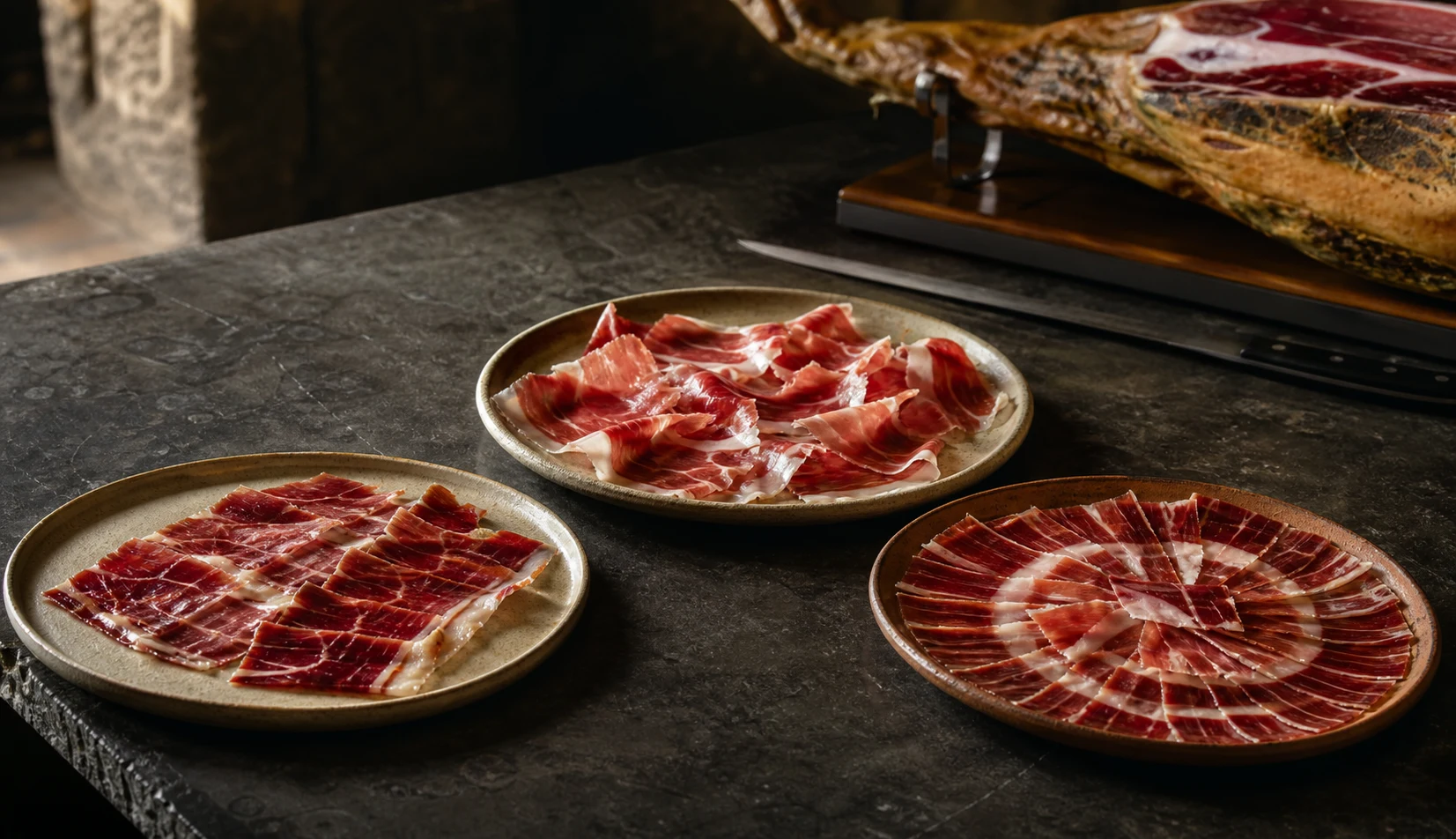
Spanish dry-cured ham is the pig’s hind leg preserved through salting, drying and maturation. Serrano and Iberian ham identify different products; paleta is the front shoulder. Breed, feed, curing and carving all influence the plate.
A whole cut, transformed by time
Cured ham keeps the structure of the leg. It is not minced meat stuffed into a casing, and it differs from cooked ham. Salt and gradual moisture loss are part of production; maturation develops the aroma and texture.
Production generally moves through salting, resting after salting, drying and maturation. Temperature, humidity, leg size and the producer’s work matter alongside time. A curing period alone does not describe the entire quality of a ham. Source: the production specification [2].
Serrano, Iberian ham and shoulder
Serrano and Iberian ham are not two grades of the same classification. Read the product name; for Iberian ham, also check the breed percentage and feeding category.
| Product | What identifies it | What to check |
|---|---|---|
| Serrano ham | Curing tradition associated with white pigs | Product name, producer and certification |
| Iberian ham | Iberian breed and regulated feeding and rearing categories | Breed percentage, seal and label |
| Paleta | Front shoulder, smaller than a hind leg | Product name, shape and edible yield |
The four Iberian ham seals
Spanish regulations use black for bellota 100% ibérico, red for bellota ibérico, green for cebo de campo ibérico and white for cebo ibérico. Bellota identifies the regulated acorn-fed category; cebo de campo and cebo are feed-fed categories with different rearing conditions. Also check the breed percentage and full product name.
Iberian does not automatically mean acorn-fed. Hoof colour is not a substitute for a verifiable label. Source: the Iberian product quality standard [1].
How to explore flavour and texture
Look at the sheen, the balance of lean meat and fat and the flexibility of a thin slice. Then consider salt, curing aromas, richness and how long the flavour lasts. These are tasting criteria, rather than a ranking of breeds.
The maza is generally the broader, meatier area; the babilla is narrower. Moisture and fat vary within the same leg. Slow, careful carving lets you explore those differences.
From the ham stand to the table
Arrange slices without piling them up and carve close to serving time. Let refrigerated slices lose their chill as appropriate for the product.
Plain bread and water work well for a simple tasting. Tomato, olive oil, vegetables and eggs offer ways to cook with ham. Add thin slices at the end when you want to preserve their texture.
Common questions
Are jamón and paleta the same?
No. Jamón is the hind leg; paleta is the front shoulder. Their shape, size and edible yield differ.
Is all Iberian ham acorn-fed?
No. Field-fed and grain-fed categories also exist. Check the full product name and breed percentage.
Sources and scope
- Iberian product quality standard · BOE
- Jamón Serrano production specification · Spanish Ministry of Agriculture
JAMÓN.IM educational overview. Serving and cooking suggestions are editorial starting points. Follow your product label and tool manufacturer’s instructions.