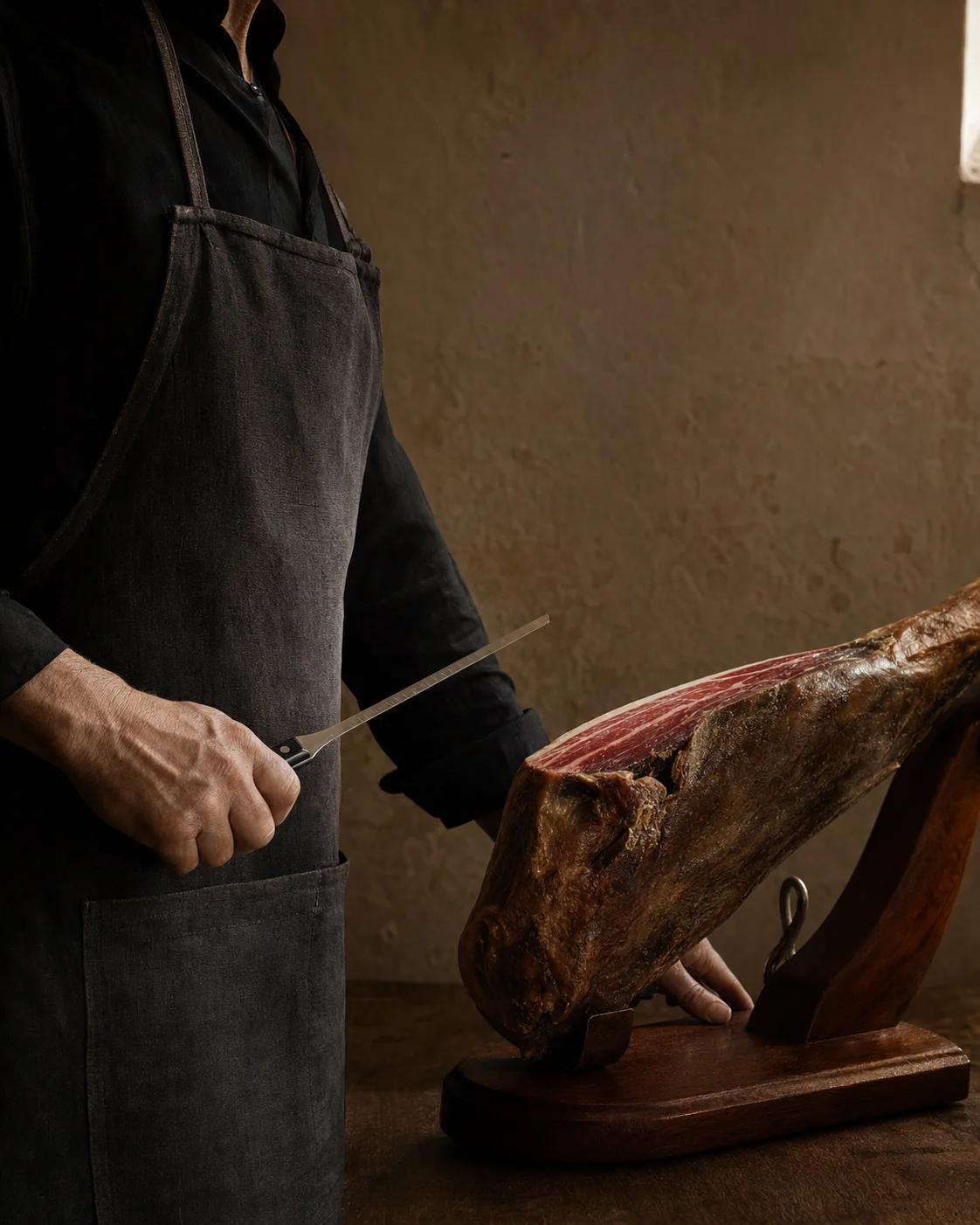
A carving station needs a securely fixed ham, tools suited to each task and space to move the blade with control. The long knife slices, the rigid knife trims and the short knife works around the bone.
Give each tool a clear task
You do not need a collection of accessories. Start with the jobs: secure, trim, slice, work around bones and maintain the edge. This is our functional selection for home carving.
| Tool | Purpose | What to check |
|---|---|---|
| Stable ham stand | Secure the leg without holding it by hand | Firm base, tight fixings and clear space |
| Ham slicing knife | Cut thin slices with gentle strokes | Long narrow blade, dry handle and maintained edge |
| Short rigid trimming knife | Remove rind and outer fat | Control; do not lever with the flexible blade |
| Short boning knife | Separate meat close to the bone | Manageable blade; work away from your fingers |
| Compatible honing steel | Maintain the edge between sharpening sessions | Follow the manufacturer’s instructions |
| Tongs and a plate | Collect and arrange slices | Clean tools and room to avoid piling slices |
Honing and sharpening are different jobs
A steel honing rod helps maintain and align an edge. It is not the same as rebuilding a worn or chipped edge: an appropriate stone or sharpening service may be needed. Ceramic or diamond rods can be abrasive; follow the instructions for your model [1].
If slicing requires increasing pressure, stop and check the tool. Compensating with force makes the movement harder to control.
Prepare the station before opening the ham
Set the stand on a firm, clear surface at a comfortable height. Light the cutting area. Tighten the fixings and check that the ham does not move before placing the knife against it.
Keep glasses, plates and other tools away from the blade’s path. Keep your free hand outside that path, with clean, dry hands and handle. Do not carve a whole ham while holding it in the air.
Clean, dry and store
Hand-wash knives where recommended by the manufacturer, dry the blade and handle, and store with the edge protected. Do not leave knives loose among other objects or soaking for long periods [2].
Tongs are useful for serving but do not replace good hygiene. Clean the stand and work surface after carving.
What if you only eat pre-sliced ham?
A packet of slices does not require a ham stand. A boneless piece needs a stable cutting surface and a knife suitable for its size. An electric slicer requires protection, cleaning and operation according to its manual; it is not necessary to start.
Common questions
Can I remove the rind with the slicing knife?
The long flexible blade is intended for slicing. Use a rigid, controllable knife for rind and outer fat.
Are tongs compulsory?
They are not essential for carving, but help collect and arrange slices without bringing fingers near the edge.
Sources and scope
JAMÓN.IM educational overview. Serving and cooking suggestions are editorial starting points. Follow your product label and tool manufacturer’s instructions.