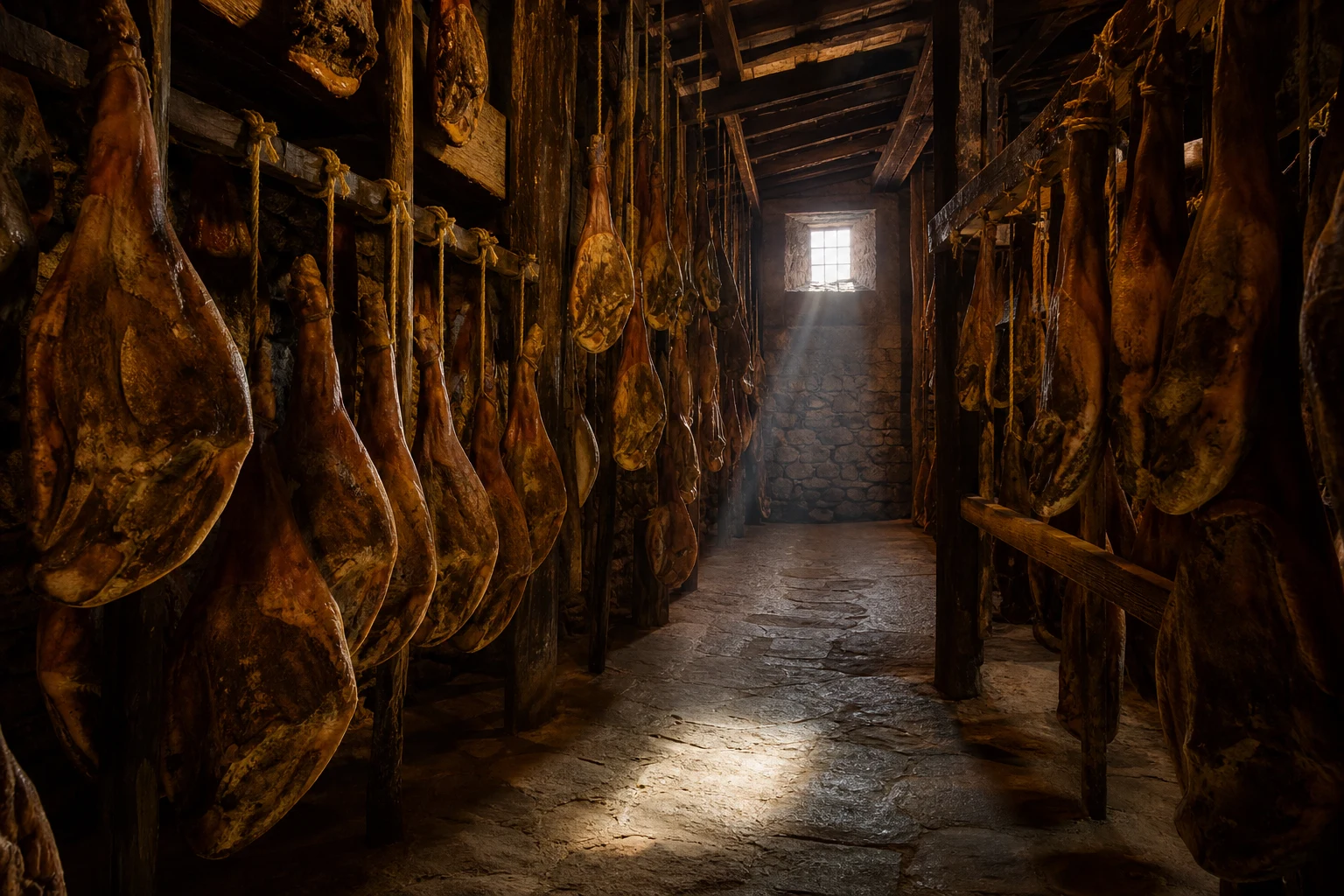
Serrano ham is made through a controlled sequence of salting, washing, resting, drying and maturation. Time, temperature, humidity and the characteristics of each leg determine how the product develops.
Selecting and preparing the leg
Production begins with legs suitable for curing and with hygiene and traceability controls. Weight, fat cover and shape affect how quickly salt and moisture loss move towards the centre.
Before salting, the leg is prepared for its intended format. Consistency matters because the later process must achieve a safe, even result while allowing for natural differences between hams.
Salting, washing and resting
Salting adds salt and supports preservation. Surface salt is then removed and a resting or post-salting stage begins, allowing salt to distribute through the leg [1].
There is no domestic formula that safely reproduces this process. Producers adjust time and conditions to the weight and characteristics of each batch within controlled systems.
Drying and gradual moisture loss
During drying, temperature, humidity and ventilation are managed so dehydration proceeds gradually. Fat also changes and contributes to aroma development.
The traditional image of a natural mountain drying room helps explain the name serrano, but quality does not depend on a postcard: it depends on sustained process control and compliance with the specification when TSG is claimed.
Maturation and flavour formation
During maturation, enzymatic and microbiological mechanisms continue to contribute to the taste and aroma properties described by the Ministry [1]. The result combines raw material, salt, moisture loss, fat and time.
More months alone do not guarantee that a ham will taste better. Suitable intensity depends on the final balance, carving and how it will be served.
Common questions
Is serrano ham cooked?
No. It is cured: salting, resting, drying and maturation transform the leg under controlled conditions.
Does longer curing always mean better ham?
Not necessarily. Time matters, but so do the leg, fat, process control, sensory balance, carving and service.
Sources and scope
- Serrano Ham TSG: method and control · Spanish Ministry of Agriculture
- Traditional Specialities Guaranteed · Spanish Ministry of Agriculture
JAMÓN.IM educational overview. Serving and cooking suggestions are editorial starting points. Follow your product label and tool manufacturer’s instructions.