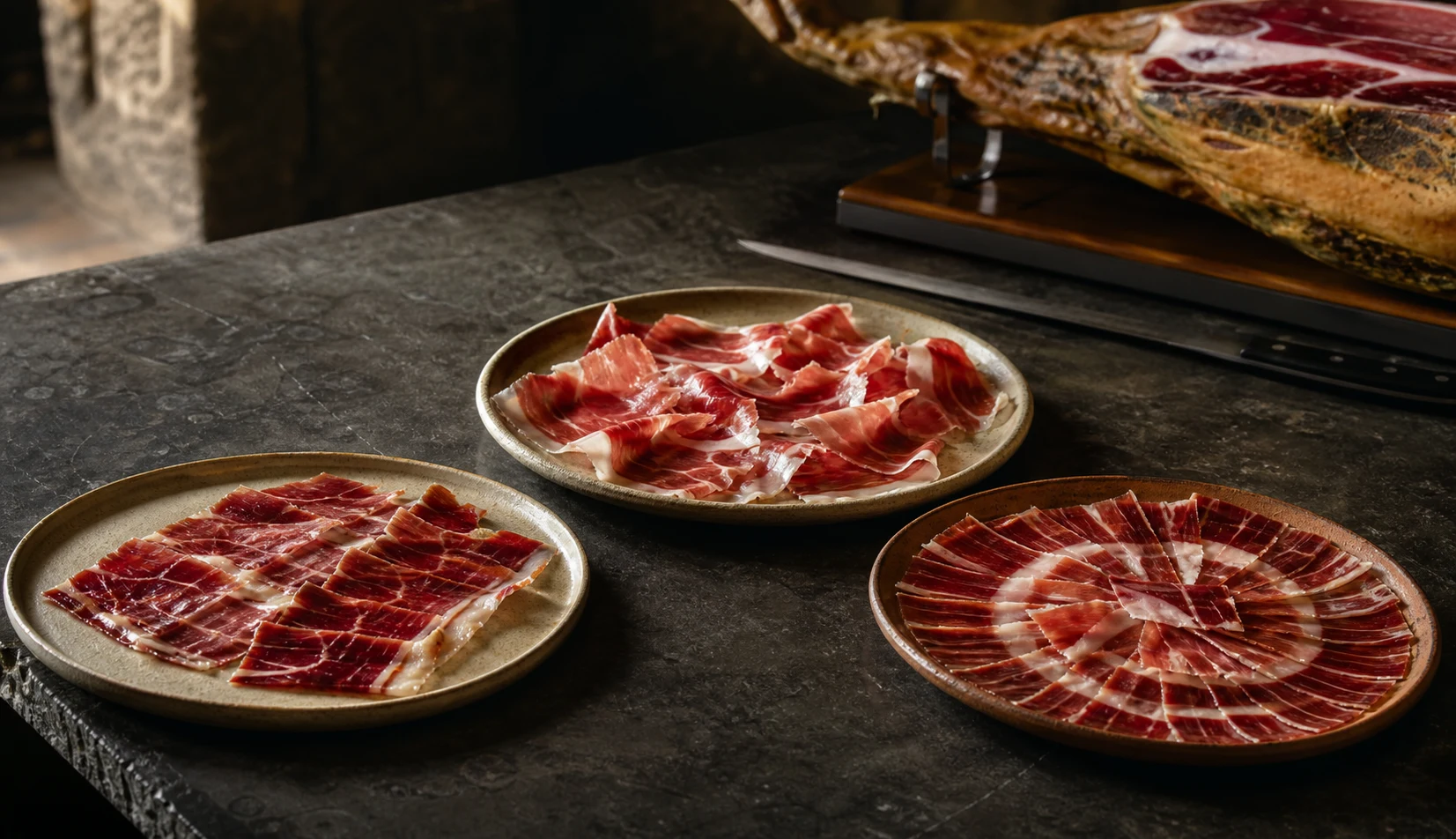
Hard white points within a cut can be amino-acid precipitates formed during curing, but a photograph cannot identify every mark. Consider location and texture, check odour, packaging and label, and stop eating and contact the producer when mould or alteration is uncertain.
What white crystals in the cut are
Dry-cured ham can develop white points or films associated with proteolysis and amino-acid precipitation. An experimental study of 169 hams identified drying temperature, weight loss, pH and salt content among the factors related to tyrosine crystals and white film [1].
A separate study of 600 Spanish dry-cured hams described white spots mainly as tyrosine deposits, with phenylalanine also present [2]. These findings explain a product phenomenon, but they cannot diagnose every household mark from appearance alone.
An internal crystal and surface growth are different
A crystal usually appears as a defined, firm point integrated into the muscle or cut surface. Surface growth may be raised, irregularly spread, fuzzy or differently coloured; do not taste a doubtful area to identify it.
AESAN explains that some moulds can produce mycotoxins and that these substances do not usually disappear through cooking [3]. Avoid absolute visual rules: when the phenomenon cannot be identified confidently, keep the packaging and contact the producer or retailer.
When to stop eating it
Stop eating if there is an abnormal odour, slimy or softened texture, swollen or damaged packaging, unexpected liquid, unusual surface growth or a change inconsistent with the product instructions. The TSG specification requires no abnormal odour or flavour and a texture that is neither pasty nor softened [4].
Do not use taste as a safety test. Take photographs, note the lot and date, keep the product as directed on its label and contact the producer; follow official notices if a food alert or recall applies.
Reduce uncertainty through proper storage
Always follow the temperature and time stated on the label, especially for sliced packs and opened hams. Use clean utensils, protect the cut surface and prevent moisture and cross-contamination.
Appearance may change during storage, and different changes do not carry the same meaning. Recording when a pack was opened and how it was stored gives the producer useful information and avoids relying on one visual sign.
Common questions
Are white spots on ham always tyrosine crystals?
No. Amino-acid crystals are documented in dry-cured ham, but not every white mark can be identified that way from a photograph alone.
Should I taste a mark to find out what it is?
No. If odour, texture, packaging or surface growth is abnormal, stop eating and contact the producer with the lot number and photographs.
Sources and scope
- Processing parameters and tyrosine precipitates in dry-cured ham · Meat Science
- Sensory and analytical properties of Spanish dry-cured ham · Food Chemistry
- Mycotoxins · AESAN
- Serrano Ham TSG: product description · Spanish Ministry of Agriculture
JAMÓN.IM educational overview. Serving and cooking suggestions are editorial starting points. Follow your product label and tool manufacturer’s instructions.